1st Grade · Money
1st Grade Money Worksheets
Identifying coins and knowing what each is worth — penny, nickel, dime and quarter — and counting a small handful. The hard part is that a bigger coin is not worth more, which is the first time size and value come apart.
Free and printer-friendly, straight from your browser — no signup.
Answer keys we check. A pack is never built unless a separate checker re-derives every answer from the printed question and agrees. How we check them →
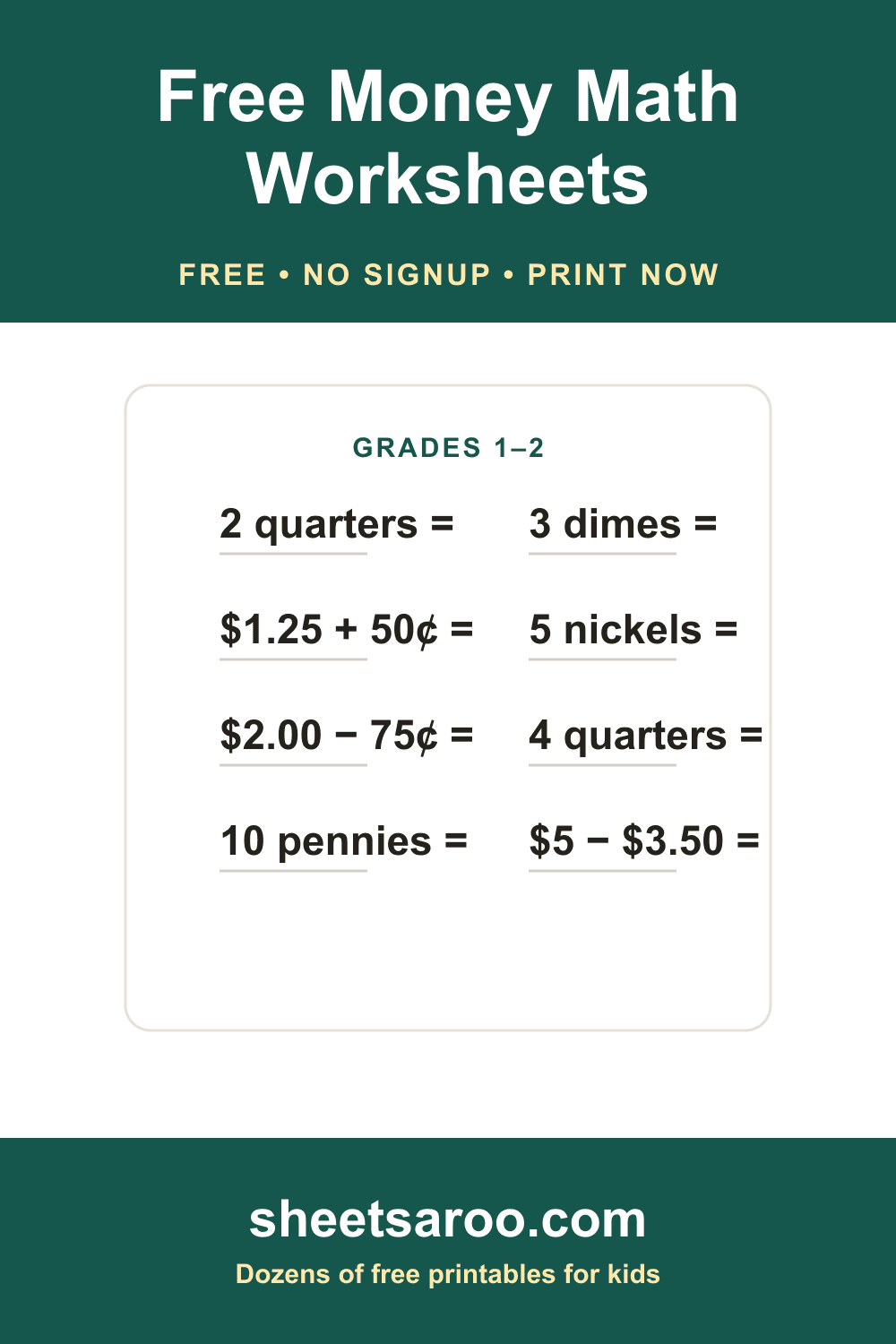
Eight versions of this worksheet
Same skill, different problems — hand a different one to each child.
Version A, in full
easy level- 1.A seed packet costs 15 cents. Circle coins that make this amount.
- 2.Two coins together are worth 35 cents. One is worth 10 cents. What is the other one worth?
- 3.Two coins together are worth 50 cents. One is worth 25 cents. What is the other one worth?
- 4.A trading card costs 6 cents. I have 11 cents. How many cents would be left over?
- 5.A magnet costs 30 cents. Circle coins that make this amount.
- 6.An apple costs 30 cents. How many pennies is that?
- 7.An eraser costs 26 cents. Circle coins that make this amount.
- 8.Two coins together are worth 35 cents. One is worth 25 cents. What is the other one worth?
- 9.A pencil grip costs 35 cents. How many pennies is that?
- 10.A glue stick costs 30 cents. How many pennies is that?
- 11.A name tag costs 50 cents. I have 75 cents. How many cents would be left over?
- 12.A juice box costs 30 cents. Hugo has 35 cents. How many cents would be left over?
These are the exact problems on version A — the first button above prints this sheet, laid out to fit cleanly on US Letter paper with an answer key on page two. Every sheet opens with a direction line and ramps from easier to harder down the page. Change the difficulty, the sheet length or the answer key on the builder.
What to watch for
The mistakes that show up most on 1st grade money — all of them visible on a finished sheet.
- Counting coins as objects rather than by value, so three coins becomes 3¢.
- Ranking a nickel above a dime because it is physically larger.
- Counting a mixed handful without sorting it first, which is the strategy that makes it tractable.
Once this is solid
2nd grade money, where dollars and cents notation arrives and totals need adding.
How to use the sheet
Print it, let your child work down the page, then mark it together from the answer key on page two. Problems get harder towards the bottom, so where they stop tells you more than the score does.
Questions parents ask
- What money skills should a 1st grader have?
- Naming the four common coins, knowing each one's value, and counting a small same-coin group. Mixed-coin totals and dollar notation are 2nd grade.
- Why does my child think a nickel is worth more than a dime?
- Because it is bigger. Money is the first place where physical size and numerical value disagree, and it genuinely takes repetition to override.