2nd Grade · Shopping Math
2nd Grade Shopping Math Worksheets
Working out the total for two or three items and the change from a note, with amounts under ten dollars. Dollars-and-cents notation is the sticking point rather than the addition.
Free and printer-friendly, straight from your browser — no signup.
Answer keys we check. A pack is never built unless a separate checker re-derives every answer from the printed question and agrees. How we check them →
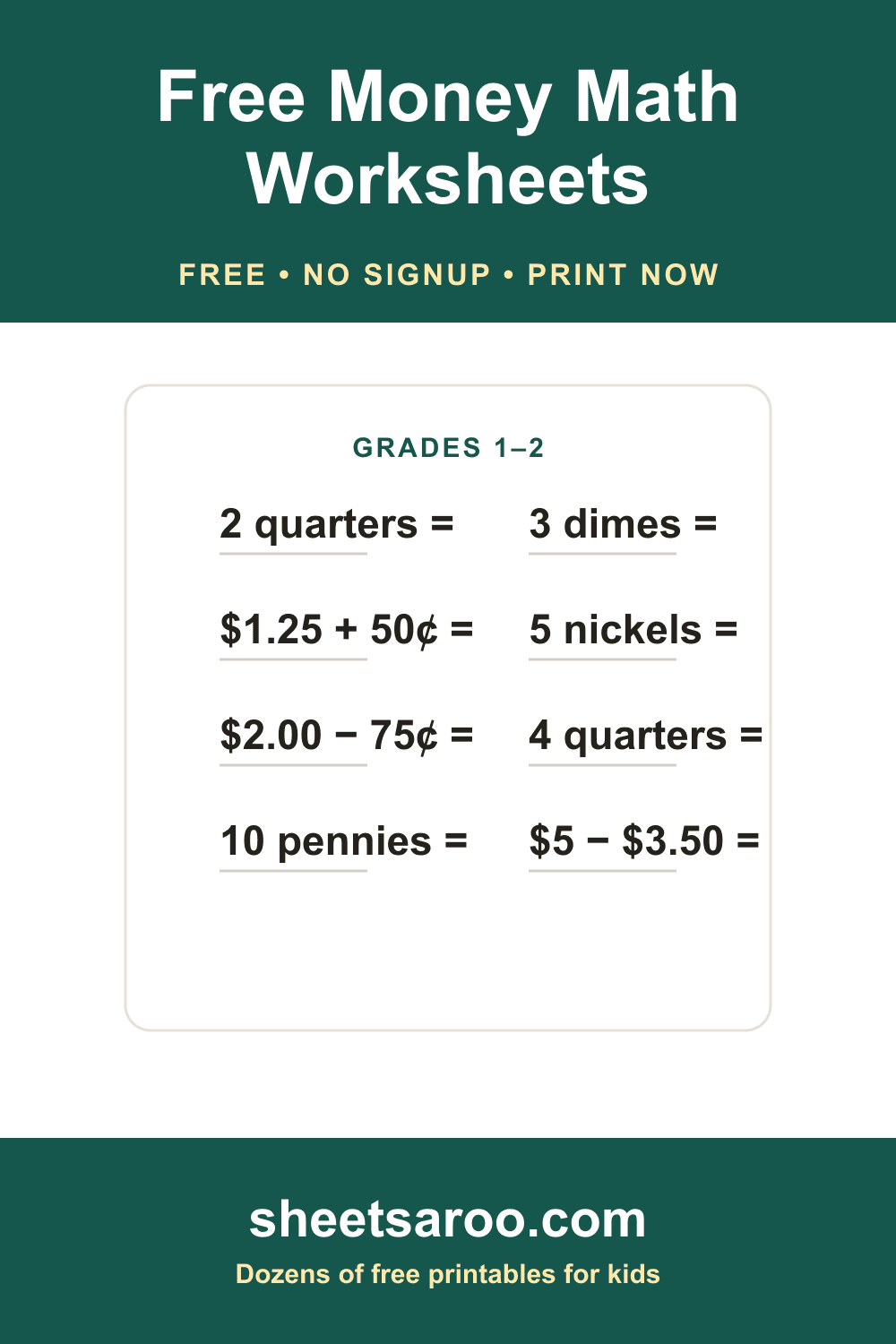
Eight versions of this worksheet
Same skill, different problems — hand a different one to each child.
Version A, in full
easy level- 1.A seed packet costs 10¢. What do 4 seed packets cost?
- 2.A seed packet costs 40¢ and a stamp costs 25¢. How much more does the seed packet cost?
- 3.A seed packet costs 20¢, a notebook costs 20¢, and a ruler costs 20¢. What do all three cost?
- 4.A magnet costs 40¢ and an apple costs 10¢. What is the total cost in cents?
- 5.A jump rope costs 75¢ and an apple costs 40¢. How much more does the jump rope cost?
- 6.An orange costs 25¢. What do 3 oranges cost?
- 7.A cookie costs 40¢, a juice box costs 5¢, and a ruler costs 25¢. What do all three cost?
- 8.Diego buys a ruler for 40¢ and pays with 100¢. How much change is left?
- 9.A sticker costs 60¢ and a bouncy ball costs 50¢. What is the total cost in cents?
- 10.I buy a granola bar for 85¢ and pay with 100¢. How much change is left?
These are the exact problems on version A — the first button above prints this sheet, laid out to fit cleanly on US Letter paper with an answer key on page two. Every sheet opens with a direction line and ramps from easier to harder down the page. Change the difficulty, the sheet length or the answer key on the builder.
What to watch for
The mistakes that show up most on 2nd grade shopping math — all of them visible on a finished sheet.
- Adding the dollars and the cents separately and writing them side by side.
- Giving change as a bare number without the dollar sign or the second decimal place.
- Totalling the items and forgetting that the question asked for change.
Once this is solid
3rd grade shopping problems, with more items and multiplication of unit prices.
How to use the sheet
Print it, let your child work down the page, then mark it together from the answer key on page two. Problems get harder towards the bottom, so where they stop tells you more than the score does.
Questions parents ask
- What money problems should a 2nd grader do?
- Totals of two or three items under ten dollars, and change from a note. Writing amounts correctly as dollars and cents is half the skill at this grade.
- Why use shopping problems instead of plain addition?
- Because the context supplies the self-check. A child who gets $14.00 change from a five-dollar note can see something is wrong, which a bare sum never offers.