3rd Grade · Multiplication
3rd Grade Multiplication Worksheets
Multiplication within 100 as the 3rd grade curriculum introduces it — products of single-digit factors, met first as equal groups and repeated addition before they become facts to recall.
Free and printer-friendly, straight from your browser — no signup.
Answer keys we check. A pack is never built unless a separate checker re-derives every answer from the printed question and agrees. How we check them →
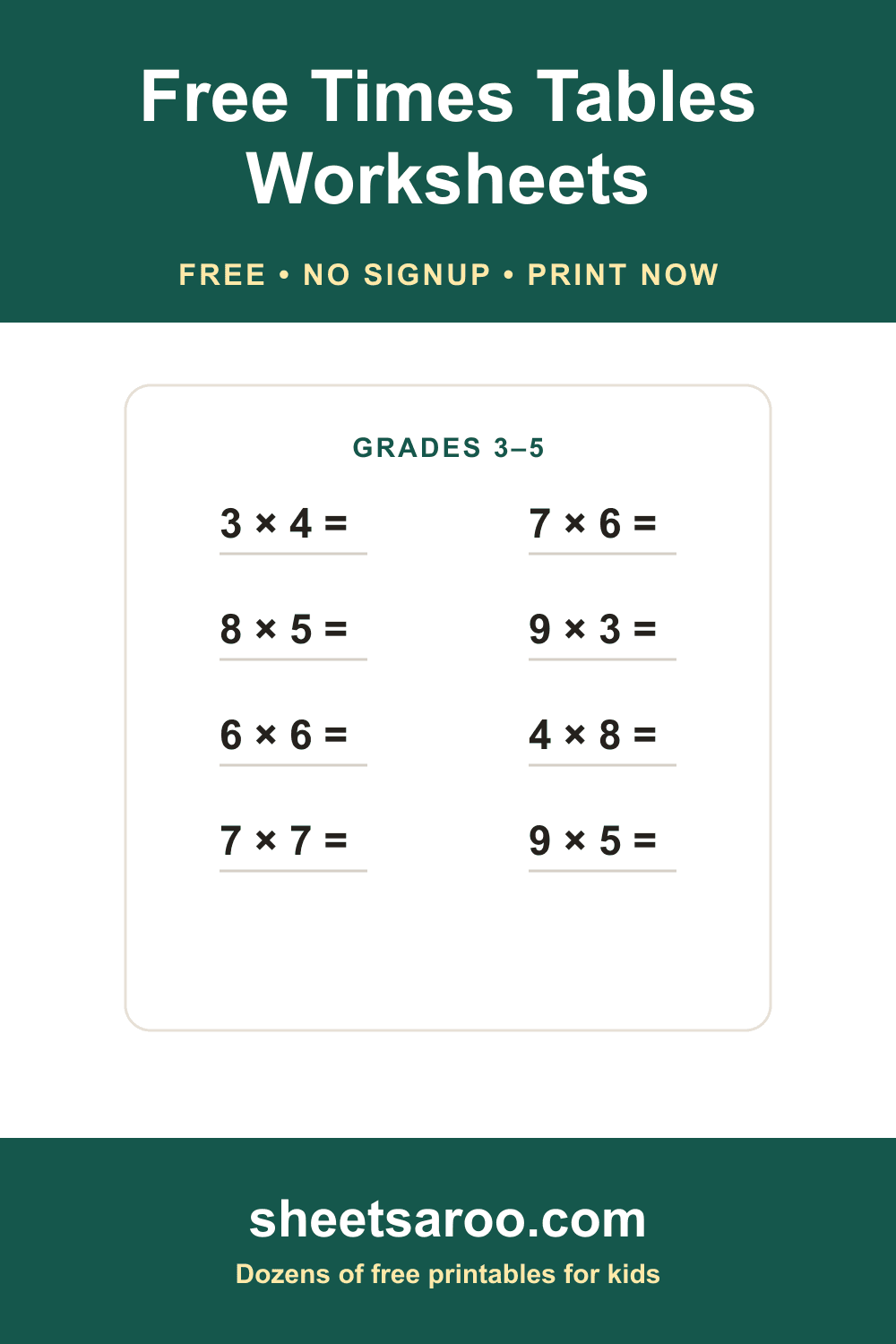
Eight versions of this worksheet
Same skill, different problems — hand a different one to each child.
Version A, in full
medium level- 1.5 x 3 =
- 2.4 x 2 =
- 3.4 x 5 =
- 4.5 x 2 =
- 5.5 x 5 =
- 6.3 x 6 =
- 7.2 x 8 =
- 8.5 x 6 =
- 9.6 x 8 =
- 10.7 x 4 =
- 11.5 x 10 =
- 12.4 x 8 =
- 13.3 x 9 =
- 14.7 x 7 =
- 15.7 x 8 =
- 16.9 x 7 =
- 17.9 x 10 =
- 18.6 x 9 =
- 19.9 x 8 =
- 20.10 x 7 =
These are the exact problems on version A — the first button above prints this sheet, laid out to fit cleanly on US Letter paper with an answer key on page two. Every sheet opens with a direction line and ramps from easier to harder down the page. Change the difficulty, the sheet length or the answer key on the builder.
What to watch for
The mistakes that show up most on 3rd grade multiplication — all of them visible on a finished sheet.
- Adding instead of multiplying under time pressure, so 7 × 8 comes out as 15.
- Knowing 6 × 4 but not 4 × 6, which means commutativity has not landed and the child is memorising twice as many facts as they need to.
- The 7s and 8s lagging everything else — normal, and worth drilling separately rather than inside a mixed sheet.
Once this is solid
4th grade multiplication, where one factor grows to two and three digits.
How to use the sheet
Print it, let your child work down the page, then mark it together from the answer key on page two. Problems get harder towards the bottom, so where they stop tells you more than the score does.
Questions parents ask
- What times tables should a 3rd grader know?
- All products of single-digit numbers, fluently, by the end of 3rd grade. In practice the 2s, 5s and 10s come first, then the squares, with the 7s and 8s last.
- Is it better to memorise tables or understand them?
- Both, in that order: equal groups and repeated addition first so the facts mean something, then recall so they are fast. Recall without meaning breaks down at word problems.